

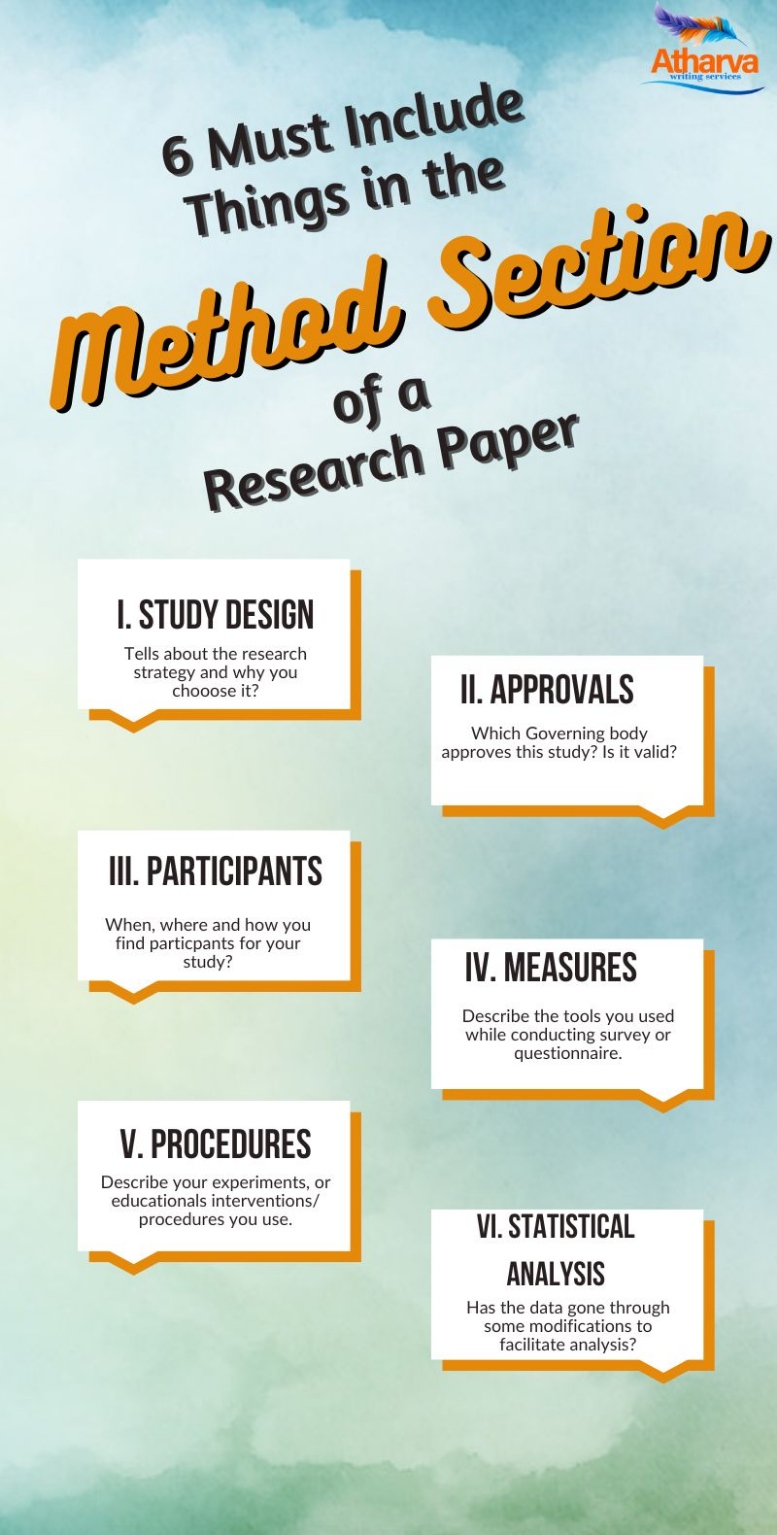
6 must include things in the Method Section of the Research Paper
One of the most important parts of any research paper is the Method section. The method section is where you explain the basic idea behind your research and how it was carried out. It’s also an opportunity to share your sources of information and help others see how you chose your point of view, collected data, and interpret findings.
It’s the other half of your research project that gives it authenticity while presenting it in a professional manner. In this post, I’ll be sharing with you some tips to write the best method section of a research paper for you.
What is the purpose of the Method section in a research paper?
A research project’s data collecting and analysis techniques are described in the Method section, which is also occasionally referred to as Methods, Materials, and Methods, or Research Design and Methods. It provides a succinct response to the query, “What did you do?”
In order for a study’s findings to be accepted as legitimate, trustworthy, and dependable, this part serves to demonstrate the integrity of the research methodologies used in the study. A method section should demonstrate that the research question(s) measured or reported what they wanted to, that they carried out research processes with accuracy and consistency, and that they analyzed their results in a deliberate, objective manner. Readers should be able to reproduce the study using the information in this section. In his guidelines for producing journal papers, Daryl Bem remarked that it should also offer readers a “sense of what it was like to be a participant.”
An ideal structure of a Method section in a research paper:
The majority of Method sections follow a chronological order. In other words, they start with the first thing that happened (such as the selection and recruitment of participants) and end with the final thing that happened (e.g., the coding and analysis of data). Most frequently, method sections are broken up into named subsections that detail various components of the project’s processes. By discipline and project type, these subsections change. The following is a list of possible subsections for a Method section:
- Research design / Study design. What was your research strategy (the general plan you used to respond to your research question)? Was this a mixed-methods, qualitative, experimental, or observational study? Why is the approach you picked accepted in the subject or field? Why is this technique the most effective one for addressing your research question(s) or achieving your objectives? Note: Occasionally, rather than a subsection, this information is included in the first paragraph of the Method section.
- Approval & Setting. What governing board or regulatory body approved this study? If your study was approved by an Institutional Review Board, what number did it assign to your project? How did you choose the research’s location? Why is this a good place for the project to be located? Do you have any prior ties to this place or institutional ties to it?
- Participants. When, where, and how did you find participants for your study? Was the goal of the study kept a secret from them? Why, if so? What were the inclusion and exclusion criteria used to choose the participants? What were the participants’ age, sex, race, level of education, and other demographic details? What steps were taken, if any, to guarantee that the participant sample is representative of a larger population? How many people were included in the targeted sample, the study’s initial and final samples, respectively? Why did participants leave the study, if this is relevant?
- Measures. Describe the tool you used whether you conducted a survey, questionnaire, or organized set of interview questions. Did you design the instrument, or did you use one that already existed (in which case, please identify and cite it)? Who used the tool to administer it? Where and how did it get given out? How many questions or objects were on the test? What subjects or themes did it address (you might want to offer some model inquiries)? What kinds of questions, such as Likert-type, multiple-choice, and open-ended ones, did it ask? What parameters were evaluated? What proof, if any, do you have that the instrument is accurate and reliable? Note: If your study makes use of many instruments, you might want to consider explaining each one separately.
- Procedure(s). Describe any experiments, clinical, or educational interventions you used. Participants were split up into groups. Was a control group used? Participants were divided into groups in what way? Where did the test or intervention happen? How long did the trial or intervention last, and did it span several sessions? Who conducted the experiment or intervention, and how did they engage the participants? What guidelines were given to participants? What mechanical devices were employed, and what were their settings, such as heart rate monitors? What kind of clinical treatment was employed, such as a medication or therapy regimen, and how was it given? What type of educational intervention was it (online courses or a series of lectures, for example)? What took place throughout the experiment or intervention?
- Data & Statistical analyses. Has the data undergone any modifications to facilitate analysis (such as converting audio recordings into transcripts)? Who carried out the interpretation and analysis of the data? How was it analyzed or decoded? Which program was used? What kinds of biometric or statistical tests were performed? How were musical scales or instruments notated? Were there any holes in the knowledge? Was any analysis-related data left out? How were coding categories or themes made? Note that this information is shown at the top of the results section in some fields.
Conclusion:
Here we have covered the parts you should add to your research paper’s method section. Hope this will really give you a brief idea about drafting a well-aligned method section for your academic paper.
You can take the help of writing services also. They will give you assistance in creating your whole paper as per the guidelines and that too in a very short span of time.
 Dr Ankita Gupta
  Dr Amit Agrawal